The Curriculum
Years 7, 8 & 9 (Key Stage 3)
 Students in Years 7, 8 and 9 are usually aged 11 to 14 years old. The curriculum is planned with due regard to the Key Stage 3 (KS3) National Curriculum, although we provide a greater variety of subjects than the National Curriculum to deliver a broad and balanced curriculum.
In Year 7, all pupils study two modern languages from a choice of Spanish, French and German and both languages are taught in form groups. In Years 8 and 9, pupils are taught in sets, according to ability. They continue to study these two languages until the end of Year 9, when they choose to continue to study one or both for GCSE.
In Year 9, several subjects form a carousel and girls are given a chance to sample a range of subjects before choosing GCSE subjects. Careers' advice starts in Year 9.
School examinations are held at the end of each academic year and the National Key Stage 3 tests in mathematics are taken in Year 9.
All students also participate in a Personal, Social & Health Education (PSHE) programme as well as a Citizenship programme.
Years 10 & 11 (GCSE)
 Students in Years 10 and 11 are usually aged 14 to 16 and follow the two-year GCSE (General Certificate of Secondary Education) course with public examinations at the end of Year 11.
All students work towards examinations in English language & English literature, mathematics and science. All girls take physics, chemistry and biology either as three separate GCSE subjects or as the Double Award examination. In addition, most girls are also required to take a modern language. Each student selects two to four option subjects from a list which includes:
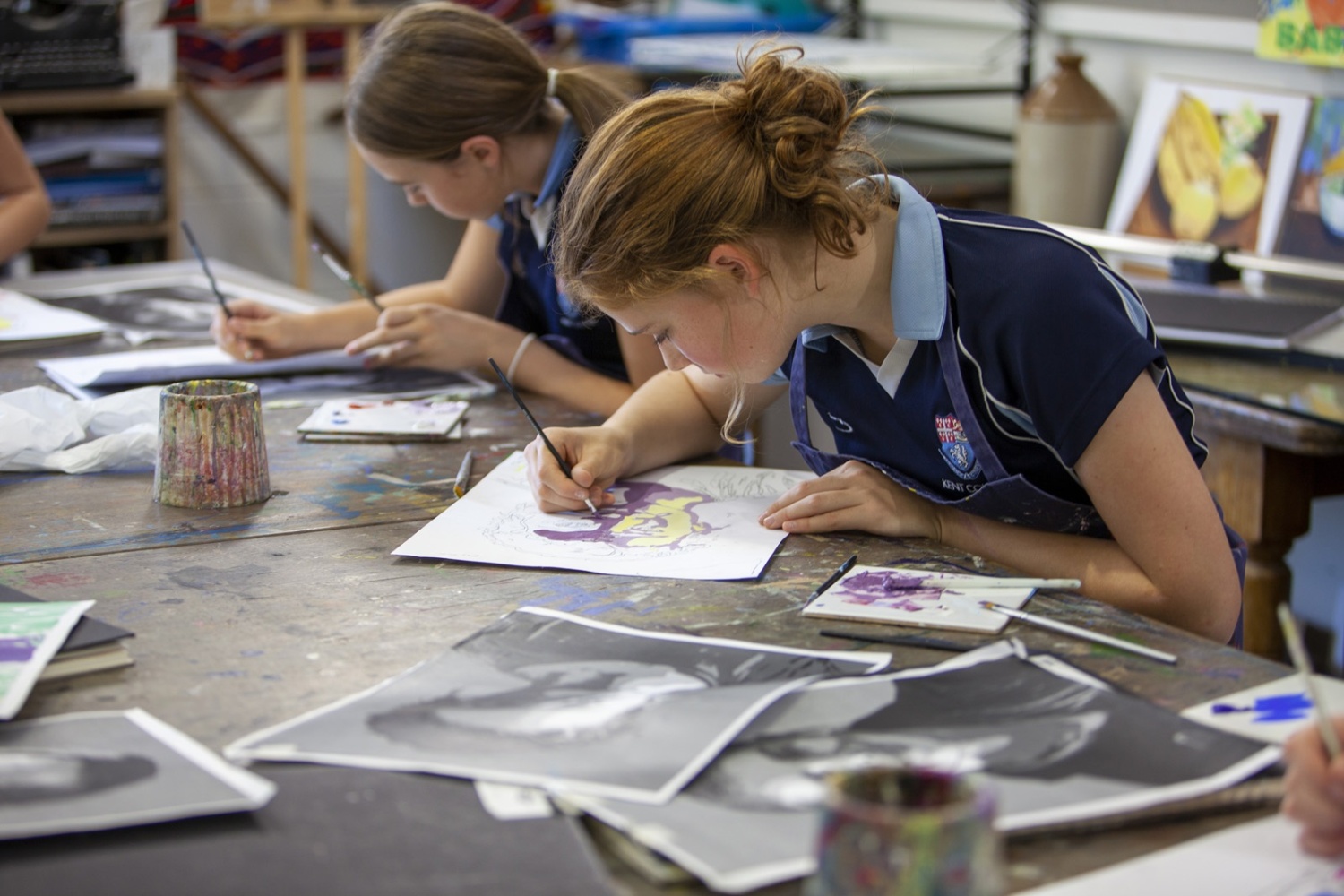
- Art
- Business & Communication Systems
- Classical Civilisation
- Drama
- Food Technology French
- German
- Textiles Technology
- History
- Latin
- Music
- Physical Education
- Religious Studies
- Geography
-
Spanish
Girls in Years 10-11 follow a Life Skills programme which covers health education, citizenship, a GCSE short course in religious education, and physical education. The careers' advice started in Year 9 continues throughout the GCSE years, with work experience in Year 11 following the GCSE examinations.
School examinations take place at the end of Year 10 and mock GCSE examinations are held in the November of Year 11, with public examinations in May/June.
Further details about GCSE courses are provided in the detailed GCSE curriculum guide which is available on request. Click here to Request a Prospectus
Sixth Form (A Level)
 Most students study four (AS) subjects in the first year and three of the same subjects (A2s) in the second year.
A levels offer the chance to study chosen subjects in depth and are the passport to higher education. During the two year course, students develop a more independent approach to learning. An exciting programme of conferences, lectures and visits features in the programme for all subjects. One afternoon per week is set aside for physical education, and there are a number of different activities from which to choose.
Click here for a list of A level subjects and further information. Full details of courses are available in the A level course booklet which is available on request.
Extensive careers advice is provided in the Sixth Form with interview workshops, visits to careers fairs and university open days. Comprehensive information is provided on higher education courses, universities and application procedures.
All A level students participate in an Enrichment Studies Programme, designed to develop key skills which will be useful in all walks of life. They participate in the University of Liverpool's Curriculum Enrichment Programme, join the School Magazine Editorial Team or take the Leith's Basic Certificate in Food and Wine. Students can also take the Guildhall School of Speech and Drama Speaking Skills Examinations. Outside visits are arranged to universities, conferences, museums and political institutions.Click here for more information on our Enrichment Studies Programme. |